Did Religious Art on the Silk Road Connect People
| Taxila ٹيکسلا | |
|---|---|
| City | |
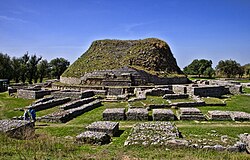 View of Taxila's Dharmarajika stupa | |
| Taxila Location in Islamic republic of pakistan | |
| Coordinates: 33°44′45″Due north 72°47′15″Eastward / 33.74583°N 72.78750°Eastward / 33.74583; 72.78750 Coordinates: 33°44′45″N 72°47′15″E / 33.74583°N 72.78750°E / 33.74583; 72.78750 | |
| State |  Pakistan Pakistan |
| Province |  Punjab Punjab |
| District | Rawalpindi |
| Elevation | 549 m (i,801 ft) |
| Population (2017) | |
| • Total | [one] |
| Population of Taxila Tehsil: 677,951 [one] | |
| Demonym(s) | Taxilan |
| Time zone | UTC+5 (PKT) |
| Postal code | 47080 |
| Dialing code | 596 |
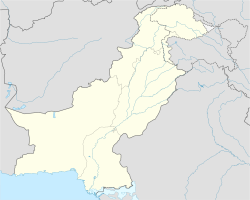

Taxila (Urdu: ٹيکسلا ; from Pāli Brahmi: 𑀢𑀔𑁆𑀔𑀲𑀺𑀮𑀸, Takhkhasilā ,[2] Sanskrit: तक्षशिला , IAST: Takṣaśilā , meaning "cloven rock") is a city in the Taxila Tehsil of Rawalpindi District, Punjab, Islamic republic of pakistan. It lies about 25 km (16 mi) northwest of Rawalpindi-Islamabad and is just south of Haripur District, Khyber Pakhtunkhwa.
One-time Taxila was an important city of ancient Bharat, situated at the pivotal junction of the Indian subcontinent and Primal Asia on the eastern shore of the Indus River.[3] Information technology was founded around 1000 BCE. Some ruins at Taxila date to the fourth dimension of the Achaemenid Empire in the 6th century BCE, followed successively by the Mauryan Empire, Indo-Greek, Indo-Scythian, and Kushan Empire periods. Owing to its strategic location, Taxila has changed hands many times over the centuries, with many empires vying for its control. When the nifty ancient trade routes connecting these regions ceased to be important, the city sank into insignificance and was finally destroyed by the nomadic Hunas in the 5th century. The renowned archaeologist Sir Alexander Cunningham rediscovered the ruins of Taxila in the mid-19th century. In 1980, Taxila was declared a UNESCO World Heritage Site.[4]
Past some accounts, the University of ancient Taxila was considered to be one of the earliest universities in the world.[five] [6] [7] [8] [9] Others do not consider it a university in the modern sense, in that the teachers living there may non have had official membership of detail colleges, and there did non seem to have existed purpose-built lecture halls and residential quarters in Taxila,[10] [xi] [12] in contrast to the later Nalanda university in eastern India.[12] [13] [14] In a 2010 study, Global Heritage Fund identified Taxila as one of 12 worldwide sites well-nigh "On the verge" of irreparable loss and impairment, citing bereft management, development pressure, looting, and war and conflict every bit primary threats.[15] Notwithstanding, significant preservation efforts have been carried out since and so past the authorities which have resulted in the site being declared as "well-preserved" by different international publications.[16] Because of the extensive preservation efforts and upkeep, the site is a popular tourist spot, attracting up to one million tourists every yr.[16] [17]
Etymology [edit]

The proper noun for the city of Taxila (Pāli Brahmi:
𑀢𑀔𑁆𑀔𑀲𑀺𑀮𑀸, Takhkhasilā ), as it appears on the Heliodorus Pillar inscription, circa 100 BCE.
Taxila was in ancient times known in Pali as Takkasila, and in Sanskrit as Takshashila (IAST: Takṣaśilā ). The urban center's Sanskrit name means "City of Cutting Stone". The city'due south ancient Sanskrit name alternately means "Rock of Taksha" – in reference to the Ramayana story that states the city was founded by Bharata, younger blood brother of the fundamental Hindu deity Rama, and named in honour of Bharata's son, Taksha.[18]
The city's modern proper name, even so, is derived from the ancient Greek recording of the ancient city's name,[xviii] [19] noted in Ptolemy's Geography.[twenty] The Greek transcription of Taxila became universally favored over time, while the Pali and Sanskrit versions fell out of use.
Faxian, who had visited the urban center, had given its proper noun's meaning every bit 'cut-off head'. With the assistance of a Jataka, he had interpreted it to be the identify where Buddha in his previous birth as Pusa or Chandaprabha cut off his head to feed a hungry lion. This tradition still persists with the surface area in front of Sirkap (also meaning 'cutting-off head') was known in the 19th century equally Babur Khana ('House of Tiger'), which alludes to the place where Buddha offered his head. In add-on, a hill range to south of Taxila Valley is called Margala ('cut off throat').[21]
In traditional sources [edit]
In Vedic texts such every bit the Shatapatha Brahmana, it is mentioned that the Vedic philosopher Uddalaka Aruni (c. seventh century BCE) had travelled to the region of Gandhara. In later Buddhist texts, the Jatakas, it is specified that Taxila was the metropolis where Aruni and his son Shvetaketu each had received their education.[22]
One of the earliest mentions of Taxila is in Pāṇini's Aṣṭādhyāyī ,[23] a Sanskrit grammar treatise dated to the fifth to 4th centuries BCE.
Much of the Hindu epic, the Mahabharata, is a conversation between Vaishampayana (a pupil of the sage, Vyasa) and King Janamejaya. It is traditionally believed that the story was get-go recited by Vaishampayana at the behest of Vyasa during the snake cede performed by Janamejaya at Takshashila.[18] The audience also included Ugrashravas, an itinerant bard, who would later recite the story to a group of priests at an ashram in the Naimisha Forest from where the story was further disseminated.[24] The Kuru Kingdom'due south heir, Parikshit (grandson of Arjuna) is said to accept been enthroned at Takshashila.[25]
The Ramayana describes Takshashila equally a magnificent metropolis famed for its wealth which was founded by Bharata, the younger blood brother of Rama. Bharata, who also founded nearby Pushkalavati, installed his two sons, Taksha and Pushkala, as the rulers of the two cities.[26]
In the Buddhist Jatakas, Taxila is described every bit the uppercase of the kingdom of Gandhara and a dandy centre of learning with world-famous teachers.[xviii] The Takkasila Jataka, more normally known as the Telapatta Jataka, tells the tale of a prince of Benares who is told that he would go the king of Takkasila if he could reach the city within seven days without falling casualty to the yakshinis who waylaid travellers in the woods.[27] [28] According to the Dipavamsa, one of Taxila's early kings was a Kshatriya named Dipankara who was succeeded by twelve sons and grandsons. Kuñjakarṇa , mentioned in the Avadanakalpalata, is some other rex associated with the city.[26]
In the Jain tradition, it is said that Rishabha, the starting time of the Tirthankaras, visited Taxila millions of years ago. His footprints were after consecrated by Bahubali who erected a throne and a dharmachakra ('wheel of the law') over them several miles in height and circumference.[26]
History [edit]
Early settlement [edit]
The region around Taxila was settled by the neolithic era, with some ruins at Taxila dating to 3360 BCE.[29] Ruins dating from the Early Harappan catamenia around 2900 BCE have also been discovered in the Taxila surface area,[29] though the expanse was somewhen abandoned after the collapse of the Indus Valley Culture.
The primeval settled occupation in Taxila Valley was found at Sarai Khola, located 2 km to the south-west of Taxila Museum, where three radiocarbon dates from Period I propose the site was offset occupied betwixt the belatedly quaternary and early 3rd millennium BCE, with deposits of polished stone celts, chert blades and a distinctive type of highly burnished pottery that shows clear signs of the use of woven baskets in the manufacturing process and the application of a slurry to the exterior surface.[30] Periods IA and Two at Sarai Khola seem to testify continuity from Period I, with the advent of red burnished wares. Still, Kot Diji-style wares were plant in greater numbers, and the Kot Diji-style forms prove signs of having been bike-thrown, marking a clear technological change from the Period I fabric. Seven radiocarbon dates were also taken from the before and afterwards Period II/Kot Diji, and seem to show this stage dates from the mid-late tertiary to early 2nd millennium BCE.[30]
Afterwards on, the first major settlement at Taxila, in Hathial mound, was established around m BCE.[31] [32] [33] By 900 BCE, the city was already involved in regional commerce, as discovered pottery shards reveal trading ties betwixt the city and Puṣkalāvatī.[34]
Later, Taxila was inhabited at Bhir Mound, dated to some time around the menstruation 800-525 BCE with these early layers begetting grooved cerise glassy ware.[35]

Achaemenid [edit]
Archaeological excavations show that the city may have grown significantly during the rule of the Persian Achaemenid Empire in the 6th century BCE. In 516 BCE, Darius I embarked on a entrada to conquer Central Asia, Ariana and Bactria, earlier marching onto what is at present Afghanistan and northern Pakistan. Emperor Darius spent the winter of 516-515 BCE in the Gandhara region surrounding Taxila, and prepared to conquer the Indus Valley, which he did in 515 BCE,[36] after which he appointed Scylax of Caryanda to explore the Indian Sea from the rima oris of the Indus to the Suez. Darius then returned to Persia via the Bolan Pass. The region connected under Achaemenid suzerainty under the reign of Xerxes I, and continued under Achaemenid rule for over a century.[37]
Taxila was sometimes ruled equally function of the Gandhara kingdom (whose capital was Pushkalavati), particularly afterwards the Achaemenid catamenia, but Taxila sometimes formed its ain independent district or city-state.[38] [39]
Hellenistic [edit]

During his invasion of the Indus Valley, Alexander the Great was able to gain control of Taxila (Aboriginal Greek: Τάξιλα)[forty] in 326 BCE without a battle, equally the urban center was surrendered by its ruler, king Omphis (Āmbhi).[37] Greek historians accompanying Alexander described Taxila as "wealthy, prosperous, and well governed".[37] Arrian writes that Alexander was welcomed by the citizens of the metropolis, and he offered sacrifices and celebrated a gymnastic and equestrian contest there.[41]
Mauryan [edit]
By 317 BCE, the Greek satraps left by Alexander were driven out,[42] and Taxila came under the control of Chandragupta Maurya, who turned Taxila into a regional majuscule. His advisor, Kautilya/Chanakya, was said to have taught at Taxila'south university.[43] Under the reign of Ashoka the Dandy, Chandragupta's grandson, the city was made a great seat of Buddhist learning, though the city was home to a small-scale rebellion during this fourth dimension.[44]
Taxila was founded in a strategic location along the ancient "Majestic Highway" that continued the Mauryan capital at Pataliputra in Bihar, with ancient Peshawar, Puṣkalāvatī, and onwards towards Cardinal Asia via Kashmir, Bactria, and Kāpiśa.[45] Taxila thus changed hands many times over the centuries, with many empires vying for its control.
Indo-Greek [edit]
In the 2nd century BCE, Taxila was annexed past the Indo-Greek kingdom of Bactria. Indo-Greeks built a new capital, Sirkap, on the contrary bank of the river from Taxila.[46] During this new catamenia of Bactrian Greek rule, several dynasties (similar Antialcidas) likely ruled from the city as their capital letter. During lulls in Greek rule, the city managed profitably on its own, to independently control several local trade guilds, who also minted most of the city's autonomous coinage. In about the 1st century BCE or 1st century CE, an Indo-Scythian king named Azilises had iii mints, one of which was at Taxila, and struck coins with obverse legends in Greek and Kharoṣṭhī.
The last Greek king of Taxila was overthrown by the Indo-Scythian chief Maues around 90 BCE.[47] Gondophares, founder of the Indo-Parthian Kingdom, conquered Taxila around twenty BCE, and fabricated Taxila his capital.[48] Co-ordinate to early Christian fable, Thomas the Apostle visited Gondophares IV effectually 46 CE,[49] possibly at Taxila given that city was Gondophares' upper-case letter urban center. Afterward five Advertizing, the Muslim ruler Muhamad Tuglak tried to destroy it.
Kushan [edit]
Around the year 50 CE, the Greek Neopythagorean philosopher Apollonius of Tyana allegedly visited Taxila, which was described past his biographer, Philostratus, writing some 200 years after, as a fortified metropolis laid out on a symmetrical plan, similar in size to Nineveh. Modernistic archeology confirms this description.[50] Inscriptions dating to 76 CE demonstrate that the urban center had come under Kushan rule by that time, subsequently the urban center was captured from the Parthians past Kujula Kadphises, founder of the Kushan Empire.[51] The great Kushan ruler Kanishka after founded Sirsukh, the most recent of the ancient settlements at Taxila.
Gupta [edit]
In the mid-quaternary century CE, the Gupta Empire occupied the territories in Eastern Gandhara, establishing a Kumaratya'due south post at Taxila. The city became well known for its trade links, including silk, sandalwood, horses, cotton, silverware, pearls, and spices. Information technology is during this time that the city heavily features in classical Indian literature – both as a middle of civilisation as well as a militarised border metropolis.[52] [53]
Taxila'due south university remained in beingness during the travels of Chinese pilgrim Faxian, who visited Taxila around 400 CE.[54] He wrote that Taxila's name translated as "the Severed Caput", and was the site of a story in the life of Buddha "where he gave his caput to a man".[55]
Decline [edit]
The Kidarites, vassals of the Hephthalite Empire are known to have invaded Taxila in c. 450 CE. Though repelled by the Gupta Emperor Skandagupta, the city would not recover- probably on account of the strong Hunnic presence in the area, breakup of trade too as the three-way war betwixt Persia, the Kidarite Country, and the Huns in Western Gandhara.
The White Huns and Alchon Huns swept over Gandhāra and Punjab around 470 CE, causing widespread destruction and destruction of Taxila'southward famous Buddhist monasteries and stupas, a blow from which the urban center would never recover. From 500 CE to 540 CE, the city languished [56] after falling under the control of the Hunnic Empire ruled past Mihirakula. A patron of Hindu Shaivism,[57] Mihirakula presided over some destruction of Buddhist sites and monasteries across northwestern regions of the Indian subcontinent.[58] [59]
Xuanzang visited India between 629 and 645 CE. Taxila which was desolate and half-ruined was visited by him in 630 CE, and found most of its sangharamas nevertheless ruined and desolate. Just a few monks remained there. He adds that the kingdom had become a dependency of Kashmir with the local leaders fighting amongst themselves for ability. He noted that information technology had some time previously been a bailiwick of Kapisa. By the ninth century, it became a dependency of the Kabul Shahis. The Turki Shahi dynasty of Kabul was replaced by the Hindu Shahi dynasty which was overthrown by Mahmud of Ghazni with the defeat of Trilochanpala.[60] [61]
Al-Usaifan's king during the reign of Al-Mu'tasim is said to have converted to Islam by Al-Biladhuri and abandoned his erstwhile faith due to the death of his son despite having priests of a temple pray for his recovery. Said to exist located between Kashmir, Multan and Kabul, al-Usaifan is identified with kingdom of Taxila by some authors.[62] [63]
Centre of learning [edit]

A view over the ruins of Sirkap.
By some accounts, Taxila was considered to be ane of the primeval (or the earliest) universities in the world.[54] [64] [65] Others practice not consider information technology a university in the modern sense, in that the teachers living there may not have had official membership of detail colleges, and there did not seem to have existed purpose-built lecture halls and residential quarters in Taxila,[10] [11] in contrast to the after Nalanda university in eastern India.[13] [fourteen] [xviii]
Taxila became a noted center of learning (including the religious teachings of Buddhism) at least several centuries BCE, and continued to attract students from around the old globe until the destruction of the city in the 5th century. It has been suggested that at its height, Taxila exerted a sort of "intellectual suzerainty" over other centres of learning in Bharat and its main concern was not with uncomplicated, but higher education.[65] Generally, a student entered Taxila at the age of 16. The ancient and the most revered scriptures, and the Eighteen Silpas or Arts, which included skills such as archery, hunting, and elephant lore, were taught, in improver to its law school, medical school, and school of military scientific discipline.[66] Students came to Taxila from far-off places such as Kashi, Kosala and Magadha, in spite of the long and arduous journeying they had to undergo, on account of the excellence of the learned teachers at that place, all recognised as authorities on their respective subjects.[67] [68]
Notable students and teachers [edit]
Taxila had peachy influence on Hindu culture and the Sanskrit language. Information technology is perhaps best known for its association with Chanakya, besides known as Kautilya, the strategist who guided Chandragupta Maurya and assisted in the founding of the Mauryan empire. Chanakya'southward Arthashastra (The knowledge of Economics) is said to have been equanimous in Taxila.[69] [ failed verification ] [70] The Ayurvedic healer Charaka besides studied at Taxila.[66] He also started teaching at Taxila in the later menses.[71] [ unreliable source? ] Pāṇini, the grammarian who codified the rules that would define Classical Sanskrit, has also been part of the community at Taxila.[72]
The institution is meaning in Buddhist tradition since it is believed that the Mahāyāna co-operative of Buddhism took shape at that place.[73] Jīvaka, the courtroom physician of the Magadha emperor Bimbisara who once cured the Buddha, and the Buddhism-supporting ruler of Kosala, Prasenajit, are some of import personalities mentioned in Pali texts who studied at Taxila.[74]
No external authorities like kings or local leaders subjected the scholastic activities at Taxila to their command. Each teacher formed his own institution, enjoying consummate autonomy in work, teaching as many students as he liked and pedagogy subjects he liked without conforming to any centralised syllabus. Report terminated when the instructor was satisfied with the student's level of achievement. In general, specialisation in a subject area took around 8 years, though this could be lengthened or shortened in accord with the intellectual abilities and dedication of the student in question. In most cases the "schools" were located within the teachers' individual houses, and at times students were advised to quit their studies if they were unable to fit into the social, intellectual and moral temper there.[75]
Knowledge was considered also sacred to be bartered for coin, and hence any stipulation that fees ought to be paid was vigorously condemned[ citation needed ]. Financial support came from the club at large, besides every bit from rich merchants and wealthy parents[ citation needed ]. Though the number of students studying under a unmarried Guru sometimes numbered in the hundreds, teachers did not deny educational activity fifty-fifty if the student was poor; free boarding and lodging was provided, and students had to do transmission work in the household[ citation needed ]. Paying students, such as princes, were taught during the day, while non-paying ones were taught at night.[76] Gurudakshina was usually expected at the completion of a student's studies, but it was substantially a mere token of respect and gratitude - many times being nothing more than a turban, a pair of sandals, or an umbrella. In cases of poor students being unable to afford even that, they could arroyo the king, who would then step in and provide something. Not providing a poor student a means to supply his Guru'due south Dakshina was considered the greatest slur on a King's reputation.[77]
Examinations were treated equally superfluous, and not considered part of the requirements to complete ane's studies[ citation needed ]. The process of teaching was critical and thorough- unless one unit was mastered completely, the pupil was not allowed to proceed to the adjacent[ citation needed ]. No convocations were held upon completion, and no written "degrees" were awarded, since it was believed that knowledge was its ain advantage. Using knowledge for earning a living or for any selfish terminate was considered sacrilegious.[75]
Students arriving at Taxila usually had completed their primary educational activity at domicile (until the age of eight), and their secondary education in the Ashrams (betwixt the ages of viii and twelve), and therefore came to Taxila chiefly to accomplish the ends of knowledge in specific disciplines.[78]
Ruins [edit]

The sites of a number of important cities noted in aboriginal Indian texts were identified by scholars early in the 19th century. The lost city of Taxila, still, was not identified until after, in 1863-64. Its identification was fabricated difficult partly due to errors in the distances recorded by Pliny in his Naturalis Historia which pointed to a location somewhere on the Haro river, two days march from the Indus. Alexander Cunningham, the founder and the commencement director-general of the Archaeological Survey of India, noticed that this position did non agree with the descriptions provided in the itineraries of Chinese pilgrims and in particular, that of Xuanzang, the 7th-century Buddhist monk. Unlike Pliny, these sources noted that the journey to Taxila from the Indus took three days and not ii. Cunningham's subsequent explorations in 1863–64 of a site at Shah-dheri convinced him that his hypothesis was right.[79]
Now every bit Hwen Thsang, on his return to China, was accompanied by laden elephants, his 3 days' journey from Takhshasila [sic] to the Indus at Utakhanda, or Ohind, must necessarily take been of the same length as those of modern days, and, consequently, the site of the city must be looked for somewhere in the neighbourhood of Kâla-ka-sarâi. This site is establish near Shah-dheri, just 1 mile to the north-due east of Kâla-ka-sarâi, in the all-encompassing ruins of a fortified urban center, effectually which I was able to trace no less than 55 stupas, of which two are as large equally the dandy Manikyala tope, twenty 8 monasteries, and 9 temples.
—Alexander Cunningham, [80]
Taxila's archaeological sites lie near mod Taxila about 35 km (22 mi) northwest of the city of Rawalpindi.[18] The sites were first excavated past John Marshall, who worked at Taxila over a menstruation of xx years from 1913.[81]

The vast archaeological site includes neolithic remains dating to 3360 BCE, and Early Harappan remains dating to 2900–2600 BCE at Sarai Kala.[29] Taxila, however, is most famous for ruins of several settlements, the earliest dating from effectually grand BCE. Information technology is as well known for its collection of Buddhist religious monuments, including the Dharmarajika stupa, the Jaulian monastery, and the Mohra Muradu monastery.
The main ruins of Taxila include four major cities, each belonging to a singled-out fourth dimension period, at three different sites. The earliest settlement at Taxila is establish in the Hathial section, which yielded pottery shards that appointment from as early equally the late 2nd millennium BCE to the 6th century BCE. The Bhir Mound ruins at the site date from the 6th century BCE, and are adjacent to Hathial. The ruins of Sirkap date to the 2nd century BCE, and were built past the region'due south Greco-Bactrian kings who ruled in the region post-obit Alexander the Great's invasion of the region in 326 BCE. The tertiary and most recent settlement is that of Sirsukh, which was congenital past rulers of the Kushan empire, who ruled from nearby Purushapura (modern Peshawar).
World Heritage Site [edit]
Taxila was designated a UNESCO World Heritage Site in 1980 in particular for the ruins of the four settlement sites which "reveal the blueprint of urban evolution on the Indian subcontinent through more than five centuries". The serial site includes a number of monuments and other historical places of annotation in the area besides the iv settlements at Bhir, Saraikala, Sirkap, and Sirsukh.[82] They number 18 in all:[83]
- Khanpur Cavern
- Saraikala , prehistoric mound
- Bhir Mound
- Sirkap (fortified urban center)
- Sirsukh (fortified ruined urban center)
- Dharmarajika stupa and monastery
- Khader Mohra (Akhuri)
- Kalawan grouping of buildings
- Giri complex of monuments
- Kunala stupa and monastery
- Jandial complex
- Lalchak and Badalpur Buddhist stuppa
- Mohra Moradu stupa and monastery
- Pippala stupa and monastery
- Jaulian stupa and monastery
- Lalchak mounds
- Buddhist remains around Bhallar stupa
- Giri Mosque and tombs
In a 2010 written report, Global Heritage Fund identified Taxila every bit one of 12 worldwide sites most "on the Verge" of irreparable loss and harm, citing insufficient direction, development pressure, looting, and war and conflict every bit primary threats.[15] In 2017, information technology was announced that Thailand would aid in conservation efforts at Taxila, as well as at Buddhist sites in the Swat Valley.[84]
Geography [edit]
Taxila is located 32 km (twenty mi) north-westward of the Pakistani capital Islamabad. The city is located approximately 549 metres (1,801 ft) above sea level.
Climate [edit]
Taxila features a boiling subtropical climate (Köppen: Cwa)[85]
| Climate data for Taxila | |||||||||||||
|---|---|---|---|---|---|---|---|---|---|---|---|---|---|
| Calendar month | Jan | Feb | Mar | April | May | Jun | Jul | Aug | Sep | Oct | Nov | Dec | Yr |
| Average loftier °C (°F) | 17 (63) | xix.5 (67.one) | 24.two (75.6) | 29.9 (85.8) | 35.4 (95.seven) | 39.5 (103.1) | 35.eight (96.4) | 33.7 (92.seven) | 33.half-dozen (92.five) | xxx.ix (87.6) | 25 (77) | 19.3 (66.7) | 28.7 (83.6) |
| Daily mean °C (°F) | 9.eight (49.six) | 12.five (54.5) | 17.3 (63.1) | 22.vi (72.7) | 27.6 (81.7) | 32 (xc) | 30.3 (86.5) | 28.6 (83.five) | 27.6 (81.7) | 22.seven (72.ix) | sixteen.2 (61.2) | 11.3 (52.3) | 21.five (lxx.8) |
| Average low °C (°F) | 2.vii (36.9) | 5.5 (41.ix) | 10.four (50.vii) | 15.three (59.five) | 19.9 (67.viii) | 24.5 (76.one) | 24.8 (76.half dozen) | 23.6 (74.v) | 21.6 (70.9) | xiv.5 (58.ane) | 7.5 (45.five) | 3.three (37.nine) | fourteen.5 (58.0) |
| Boilerplate precipitation mm (inches) | 58 (2.3) | 56 (ii.2) | 68 (2.7) | 44 (one.7) | 38 (1.5) | 37 (1.five) | 237 (9.3) | 236 (9.3) | 92 (three.6) | 23 (0.ix) | 16 (0.6) | 36 (1.four) | 941 (37) |
| Source: Climate-Data.org, altitude: 497m[85] | |||||||||||||
Economy [edit]
Tourism [edit]

Taxila is i of northern Islamic republic of pakistan's most important tourist destinations and is home to the Taxila Museum which holds a big number of artifacts from Taxila's excavations. Though the number of foreign visitors to the site drastically declined post-obit the start of an Islamist insurgency in Pakistan in 2007, company numbers began to noticeably improve by 2017,[86] afterwards the law and order situation in the region had greatly improved following the start of the 2014 Zarb-e-Azb entrada launched by the Pakistani Army confronting radical Islamist militants.
In 2017, the Pakistani regime appear its intention to develop Taxila into a site for Buddhist religious pilgrimage.[87] As part of the efforts, it announced that an exhibition on the Buddhist heritage of the region would be held in Thailand, and that the Thai government would assist in conservation efforts at the site.[88] Relics from Taxila were as well sent to Sri Lanka for the 2017 Vesak holiday as part of an effort to showcase the region's Buddhist heritage.[89] The Islamic republic of pakistan Tourism Development Corporation also announced in 2017 that a tour motorcoach service would exist launched between the Taxila Museum and Islamabad.[90]
In add-on to the ruins of aboriginal Taxila, relics of Mughal gardens and vestiges of historical Grand Trunk Route are as well found in Taxila. Nicholson'south Obelisk, named in laurels of Brigadier John Nicholson who died during the Sepoy Mutiny of 1857, is a monument from the British era that welcomes travelers arriving from Rawalpindi/Islamabad.
Manufacture [edit]
Taxila is home to Heavy Industries Taxila, a major Pakistani defence, military contractor, engineering conglomerate. The city's economy is also closely linked to the large Islamic republic of pakistan Ordnance Factories at nearby Wah Cantt, which employs 27,000 people. Cottage and household industries include stoneware, pottery and footwear.
Transportation [edit]
Rail [edit]
Taxila is served by the Taxila Cantonment Junction railway station. Taxila Junction is served by the Karachi–Peshawar Railway Line, and is the southern terminus of the Khunjerab Railway, which connects Taxila to the Havelian railway station. A planned extension of the railway will eventually connect Taxila to Prc's Southern Xinjiang Railway in Kashgar, every bit part of the Communist china–Islamic republic of pakistan Economical Corridor.
Road [edit]

The ancient Yard Body Road is designated as N-v National Highway, and connects the city to the Afghan edge, and northern Punjab. The Karakoram Highway's southern terminus is in nearby Hasan Abdal, and connects Taxila to the Chinese border near the Hunza Valley.
The city is linked to Peshawar and Islamabad by the M-i Motorway, which in turn offers wider motorway access to Lahore via the K-2 State highway, and Faisalabad via the M-4 Freeway.
Air [edit]
The nearest airport to Taxila is Islamabad International Airdrome located 36.five kilometers away. Peshawar'southward Bacha Khan International Airport is 155 kilometers away.
Education [edit]

Taxila is home to many secondary educational institutes including CIIT Wah Campus, and HITEC Academy. The Academy of Engineering and Technology, Taxila was established in 1975 as a campus of the Academy of Technology and Technology, Lahore, and offers available, chief, and doctoral degrees in engineering science.
Ancient ruins [edit]
The Ruins of Taxila include four major cities, each belonging to a distinct time menstruum, at three dissimilar sites. The earliest settlement at Taxila is found in the Hathial section, which yielded pottery shards that engagement from as early as the late 2d millennium BCE to the sixth century BCE. The Bhir Mound ruins at the site appointment from the 6th century BCE, and are side by side to Hathial. The ruins of Sirkap date to the 2d century BCE, and were congenital by the region's Greco-Bactrian kings who ruled in the region following Alexander the Great's invasion of the region in 326 BCE. The third and near recent settlement is that of Sirsukh, which was built by rulers of the Kushan empire, who ruled from nearby Purushapura (mod Peshawar).
Culture [edit]
Modernistic Taxila is a mix of relatively wealthy urban, and poorer rural environs. Urban residential areas are general in the form of planned housing colonies populated by workers of the heavy mechanical complex & heavy industries, educational institutes and hospitals that are located in the surface area.
Museums [edit]
Taxila Museum has one of the well-nigh meaning and comprehensive collections of stone Buddhist sculpture from the first to the 7th centuries in Pakistan (known as Gandharan art. The core of the collection comes from excavated sites in the Taxila Valley, particularly the excavations of Sir John Marshall. Other objects come from excavated sites elsewhere in Gandhara, from donations such as the Ram Das Collection, or from material confiscated by the police and community authorities.
-

A coin from second century BCE Taxila.
-
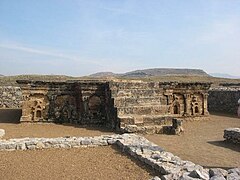
Stupa base at Sirkap, busy with Hindu, Buddhist and Greek temple fronts.
-

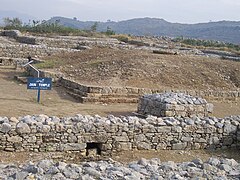
Stupa in Taxila.

Archaeological artifacts from the Indo-Greek strata at Taxila (John Marshall "Taxila, Archeological excavations"). From top, left: * Fluted cup (Bhir Mound, stratum i) * Cup with rosacea and decorative scroll (Bhir Mound, stratum ane) * Stone palette with an individual on a couch beingness crowned past a standing woman, and served (Sirkap, stratum v) * Handle with a double depiction of a philosopher (Sirkap, stratum 5) * Woman with grin (Sirkap, stratum 5) * Homo with moustache (Sirkap, stratum 5)
Gallery [edit]
-
A coin from 2nd century BCE Taxila.
-

Reliquary in the form of a crystal goose dating to the 1st Century Advertisement in the British Museum.
-
-
Stupa base at Sirkap, decorated with Hindu, Buddhist and Greek temple fronts.
-
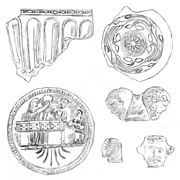
Archaeological artifacts from the Indo-Greek strata at Taxila from John Marshall "Taxila Archeological excavations").
-
Stupa in Taxila.
Encounter besides [edit]
- Taxila (satrapy)
- Harappa
Notes [edit]
- ^ a b http://www.pbs.gov.pk/sites/default/files/population_census/Administrative%20Units.pdf[ bare URL PDF ]
- ^ The name for the urban center of Taxila as it appears on the Heliodorus Pillar inscription, circa 100 BCE.
- ^ Raymond Allchin, Bridget Allchin, The Rise of Civilisation in India and Pakistan. Cambridge University Press, 1982 p.127 ISBN 052128550X
- ^ UNESCO World Heritage Site, 1980. Taxila: Multiple Locations. Retrieved xiii January 2007.
- ^ Needham, Joseph (2004). Within the Four Seas: The Dialogue of Eastward and West. Routledge. ISBN978-0-415-36166-8.
- ^ Kulke & Rothermund 2004:
"In the early centuries the center of Buddhist scholarship was the University of Taxila."
- ^ Balakrishnan Muniapan, Junaid M. Shaikh (2007), "Lessons in corporate governance from Kautilya's Arthashastra in ancient India", World Review of Entrepreneurship, Management and Sustainable Development three (1):
"Kautilya was also a Professor of Politics and Economics at Taxila University. Taxila University is one of the oldest known universities in the world and it was the chief learning centre in ancient Republic of india."
- ^ Mookerji 1989, p. 478:
"Thus the various centres of learning in different parts of the country became affiliated, every bit information technology were, to the educational centre, or the primal academy, of Taxila which exercised a kind of intellectual suzerainty over the wide world of messages in Bharat."
- ^ Mookerji 1989, p. 479:
"This shows that Taxila was a seat not of elementary, but higher, education, of colleges or a university as distinguished from schools."
- ^ a b Altekar 1965, p. 109:
"Information technology may exist observed at the start that Taxila did not possess any colleges or university in the modern sense of the term."
- ^ a b F. W. Thomas (1944), in Marshall (1951), p. 81:
"We come up across several Jātaka stories near the students and teachers of Takshaśilā, only not a single episode fifty-fifty remotely suggests that the different 'world renowned' teachers living in that city belonged to a particular college or university of the modern blazon."
- ^ a b "Taxila". Encyclopædia Britannica. 2007. Archived from the original on 22 December 2007:
"Taxila, besides being a provincial seat, was also a middle of learning. It was not a academy town with lecture halls and residential quarters, such as accept been establish at Nalanda in the Indian state of Bihar."
- ^ a b "Nalanda" (2007). Encarta.
- ^ a b "Nalanda" (2001). Columbia Encyclopedia.
- ^ a b "Global Heritage in the Peril: Sites on the Verge". Global Heritage Fund. Archived from the original on 20 August 2012.
- ^ a b Raheela Nazir (12 May 2018). "Feature: Pakistan in efforts to rejuvenate Taxila, one of most important archaeological sites in Asia". XINHUANET.com . Retrieved 15 October 2018.
- ^ "Taxila: an analogy of fascinating influences of multiple civilisations". Daily Times. 13 May 2018.
- ^ a b c d due east f "Taxila, ancient metropolis, Pakistan". Encyclopædia Britannica . Retrieved 16 May 2017.
- ^ Lahiri, Nayanjot (2015). Ashoka in Ancient Bharat. Chapter iii: Harvard University Press. ISBN9780674915251.
{{cite volume}}: CS1 maint: location (link) - ^ J. W. McCrindle, The Invasion of Republic of india by Alexander the Great as Described past Arrian, Q. Curtius, Diodorus, Plutarch and Justin, Westminster, Constable, 1893, pp.343–344.
- ^ Saifur Rahman Dar. "Artifact, Meaning and Origin of the Proper noun Takshashila or Taxila". The Panjab By and Present. 11 (2): 11.
- ^ Raychaudhuri, Hem Chandra (1923), Political history of ancient India, from the accession of Parikshit to the extinction of the Gupta dynasty, pp. 17–18, 25–26
- ^ Scharfe 2002, pp. 140–141.
- ^ Davis 2014, p. 38.
- ^ Kosambi 1975, p. 126.
- ^ a b c Marshall 2013, p. 10.
- ^ Malalasekera 1937, Telapatta Jātaka (No.96):
"The Bodhisatta was once the youngest of ane hundred sons of the king of Benares. He heard from the Pacceka Buddhas, who took their meals in the palace, that he would become king of Takkasilā if he could reach information technology without falling a prey to the ogresses who waylaid travellers in the woods. Thereupon, he set out with five of his brothers who wished to accompany him. On the mode through the forest the v in succession succumbed to the charms of the ogresses, and were devoured. One ogress followed the Bodhisatta right up to the gates of Takkasilā, where the king took her into the palace, paying no heed to the Bodhisatta'due south warning. The male monarch succumbed to her wiles, and, during the night, the king and all the inhabitants of the palace were eaten past the ogress and her companions. The people, realising the sagacity and strength of volition of the Bodhisatta, made him their king."
- ^ Appleton 2016, pp. 23, 82.
- ^ a b c Allchin & Allchin 1988, p. 127.
- ^ a b Petrie, Cameron, (2013). "Taxila", in D. K. Chakrabarti and M. Lal (eds.), History of Ancient India III: The Texts, and Political History and Administration till c. 200 BC, Vivekananda International Foundation, Aryan Books International, Delhi, p. 654.
- ^ Allchin & Allchin 1988, p. 314: "The first city of Taxila at Hathial goes back at to the lowest degree to c. k B.C."
- ^ Heart, UNESCO World Heritage. "Taxila". whc.unesco.org.
- ^ Scharfe 2002, p. 141.
- ^ Mohan Pant, Shūji Funo, Stupa and Swastika: Historical Urban Planning Principles in Nepal's Kathmandu Valley. NUS Press, 2007 ISBN 9971693720, citing Allchin: 1980
- ^ Petrie, Cameron, (2013). "Taxila", in D. Thousand. Chakrabarti and M. Lal (eds.), History of Aboriginal Bharat III: The Texts, and Political History and Administration till c. 200 BC, Vivekananda International Foundation, Aryan Books International, Delhi, p. 656.
- ^ "Darius the Great - 8. Travels - Livius". www.livius.org.
- ^ a b c Marshall 1951, p. 83.
- ^ Samad, Rafi U (2011). The Grandeur of Gandhara: The Ancient Buddhist Civilization of the Swat, Peshawar, Kabul and Indus Valleys. ISBN9780875868592.
- ^ Marshall 1951, pp. xvi–17, xxx, 71.
- ^ Stephanus of Byzantium, Ethnica, § T602.8
- ^ Arrian, Anabasis of Alexander, § 5.8
- ^ Mookerji 1988, p. 31.
- ^ Mookerji 1988, pp. 22, 54.
- ^ Thapar 1997, p. 52.
- ^ Thapar 1997, p. 237.
- ^ Kulke & Rothermund 2004, p. 75.
- ^ Marshall 1951, p. 84.
- ^ Marshall 1951, p. 85.
- ^ Medlycott 1905, Chapter: The Apostle and Gondophares the Indian Rex.
- ^ Marshall 2013, pp. 28–30, 69, 88–89.
- ^ Kulke & Rothermund 2004, p. 80.
- ^ Kumar, Sanjeev (2017). Treasures of the Gupta Empire - A Catalogue of Coins of the Gupta Dynasty.
- ^ Ancient Republic of india by Ramesh Chandra Majumdar
- ^ a b Needham 2005, p. 135.
- ^ A Record of Buddhistic Kingdoms, Existence an Account by the Chinese Monk Fa-Hsien of his Travels in India and Ceylon in Search of the Buddhist Books of Subject, Affiliate 11
- ^ Marshall 1951, p. 86.
- ^ Mihirakula, Encyclopaedia Britannica
- ^ Li Rongxi (1996), The Great Tang Dynasty Tape of the Western Regions, Bukkyo Dendo Kyokai and Numata Center for Buddhist Translation and Enquiry, Berkeley, pp. 97–100
- ^ Singh, Upinder (2017). Political Violence in Ancient India. Harvard University Press. p. 241. ISBN978-0-674-97527-9.
- ^ A Guide to Taxila. Cambridge Academy Press. 20 June 2013. pp. 39, 46. ISBN9781107615441.
- ^ Elizabeth Errington; Vesta Sarkhosh Curtis. Persepolis to the Punjab: Exploring Aboriginal Iran, Afghanistan and Pakistan. British Museum Printing. p. 134.
- ^ The Panjab Past and Nowadays - Volume 11 - Folio 18
- ^ Islamic republic of pakistan Journal of History and Culture - Volumes 4-5 - Page 11
- ^ Kulke & Rothermund 2004, p. 157.
- ^ a b Mookerji 1989, pp. 478–479.
- ^ a b Mookerji 1989, pp. 478–489.
- ^ Prakash 1964, p.[ page needed ]:
"Students from Magadha traversed the vast distances of northern India in order to bring together the schools and colleges of Taxila. Nosotros learn from Pali texts that Brahmana youths, Khattiya princes and sons of setthis from Rajagriha, Kashi, Kosala and other places went to Taxila for learning the Vedas and 18 sciences and arts."
- ^ Apte, p. 9.
- ^ "Kautilya". Encyclopædia Britannica. Archived from the original on 10 January 2008.
- ^ Mookerji 1988, p. 17.
- ^ "A Note on Ancient History". Takshila Institute. Retrieved i Apr 2012.
- ^ Prakash 1964, p.[ page needed ]:
"Pāṇini and Kautilya, two masterminds of ancient times, were also brought upward in the academic traditions of Taxila"
- ^ Gupta, Aryan. "Taxila and Mahayana Buddhism". School near Heart.
- ^ Prakash 1964, p.[ page needed ]:
"As well, Jivaka, the famous physician of Bimbisara who cured the Buddha, learnt the science of medicine under a far-famed instructor at Taxila and on his render was appointed court-medico at Magadha. Another illustrious product of Taxila was the enlightened ruler of Kosala, Prasenajit, who is intimately associated with the events of the time of the Buddha."
- ^ a b Apte, pp. 9–x.
- ^ Apte, pp. sixteen–17.
- ^ Apte, pp. xviii–19.
- ^ Apte, p. 11.
- ^ Singh, Upinder 2008, p. 265.
- ^ Cunningham 1871, p. 105.
- ^ Wheeler, Mortimer. "Marshall, Sir John Hubert (1876–1958)". Oxford Lexicon of National Biography (online ed.). Oxford University Printing. doi:10.1093/ref:odnb/34896. Retrieved 4 July 2017. (Subscription or United kingdom public library membership required.)
- ^ "Taxila". UNESCO. Retrieved 1 June 2017.
- ^ "Taxila Map". whc.unesco.org. UNESCO World Heritage Eye. Retrieved 29 June 2017.
- ^ "Thailand to provide assistance for restoration of Ghandhara Archelogical [sic] sites". The Nation. 16 January 2017. Retrieved 1 June 2017.
- ^ a b "Climate: Taxila – Climate graph, Temperature graph, Climate table". Climate-Data.org. Retrieved 14 June 2017.
- ^ "Tourism manufacture picking up as police and guild situation improved". Aaj Television. 24 Jan 2017. Retrieved 1 June 2017.
- ^ "PTDC to organize Buddhists' conference to promote tourism". Pakistan Today. xi March 2017. Retrieved ane June 2017.
- ^ "Pakistan to organise Buddhism heritage exhibition in Thailand". Geo News. 13 March 2017. Retrieved i June 2017.
- ^ "As China Pushes for a 'Buddhist' Globalisation, India Isn't Making the Most of Its Legacy". The Wire. xi May 2017. Retrieved i June 2017.
- ^ "Double decker tourist buses to exist run in twin cities: PTDC". Daily Times. two January 2017. Retrieved ane June 2017.
References [edit]
- Allchin, F. Raymond (1993). "The Urban Position of Taxila and Its Identify in Northwest India-Islamic republic of pakistan". Studies in the History of Fine art. 31: 69–81. JSTOR 42620473.
- Allchin, Bridget; Allchin, Raymond (1988). The ascent of civilization in India and Pakistan. Cambridge [u.a.]: Cambridge University Printing. ISBN978-0521285506.
- Altekar, Anant Sadashiv (1965). Education in Ancient India (6th ed.). Nand Kishore.
- Appleton, Naomi (2016). Jataka Stories in Theravada Buddhism: Narrating the Bodhisatta Path. Routledge. ISBN9781317111252.
- Apte, DG (c. 1950). Universities in ancient Bharat. Baroda: Faculty of Educational activity and Psychology, Maharaja Sayajirao University. [ unreliable source? ]
- Cunningham, Alexander (1871). The Ancient Geography of India: The Buddhist Menses, Including the Campaigns of Alexander, and the Travels of Hwen-Thsang. Cambridge, NY: Cambridge University Press. ISBN9781108056458.
- Davis, Richard H. (2014). The "Bhagavad Gita": A Biography. Princeton Academy Press. ISBN9781400851973.
- Kosambi, Damodar Dharmanand (1975) [first published 1956]. An Introduction to the Report of Indian History (Revised Second ed.). Bombay: Popular Prakashan. p. 126.
- Kulke, Hermann; Rothermund, Dietmar (2004). A History of Bharat (quaternary ed.). New York: Routledge. ISBN978-0-415-32919-4.
- Lahiri, Nayanjot (2015). Ashoka in Aboriginal Republic of india. Harvard University Press. ISBN9780674915251 . Retrieved sixteen May 2017.
- Malalasekera, Grand. P. (1937). Dictionary of Pali Proper Names. Asian Educational Services (published 2003). ISBN9788120618237.
- Marshall, John (1951). Taxila: Structural remains – Book 1. University Printing.
- Marshall, John (2013) [1960]. A guide to Taxila (Fourth ed.). ISBN9781107615441.
- Medlycott, A.E. (1905). India and the Apostle Thomas. London: David Nutt.
- Mookerji, Radha Kumud (1988) [1966]. Chandragupta Maurya and his times (quaternary ed.). Delhi: Motilal Banarsidass. ISBN978-81-208-0405-0.
- Mookerji, Radha Kumud (1989) [1951]. Ancient Indian instruction: Brahmanical and Buddhist (2nd ed.). Delhi: Motilal Banarsidass. ISBN978-81-208-0423-iv.
- Needham, Joseph (2005) [1969]. Within the four seas : the dialogue of East and West. London and New York: Routledge. ISBN978-0-415-36166-8.
- Prakash, Buddha (1964). Political And Social Movements in Aboriginal Punjab. Motilal Banarsidass. ISBN9788120824584.
- Scharfe, Hartmut (2002). Didactics in ancient Republic of india. Leiden [u.a.]: Brill. ISBN9789004125568.
- Singh, Upinder (2008). A history of ancient and early medieval Republic of india : from the Rock Historic period to the 12th century. New Delhi: Pearson Education. ISBN9788131711200.
- Thapar, Romila (1997). Aśoka and the pass up of the Mauryas (Rev. ed.). Delhi: Oxford University Press. ISBN978-0-xix-563932-ii.
- Trautmann, Thomas R. (1971). Kauṭilya and the Arthaśāstra: a statistical investigation of the authorship and development of the text. Brill.
External links [edit]
 | Wikimedia Commons has media related to Taxila. |
 | Wikivoyage has a travel guide for Taxila . |
- Explore Taxila with Google Globe on Global Heritage Network
- Guide to Celebrated Taxila by Ahmad Hasan Dani in 10 chapters
- "Taxila", by Jona Lendering
- Map of Gandhara archaeological sites, from the Huntington Collection, Ohio State University (large file)
- Taxila: An Ancient Indian University by Southward. Srikanta Sastri
- John Marshall, A guide to Taxila (1918) on Archive.org
- Telapatta Jataka also known equally the Takkasila Jataka
Source: https://en.wikipedia.org/wiki/Taxila
0 Response to "Did Religious Art on the Silk Road Connect People"
Postar um comentário